Ph.D. Student in Computer Science
Texas A&M University

About Me

Human–Computer Interaction · Novel Sensing · Digital Fabrication · Interactive Physical Systems

I am a fourth year Ph.D. student in Computer Science at Texas A&M University, where I work in the HCI Engineering & Design (HCIED) Lab, under the guidance of Dr. Jeeeun Kim. My research explores how everyday objects can be designed to sense, respond to, and adapt to human activities.

I develop novel sensing and interaction techniques by exploring how different physical mechanisms and digitally fabricated structures can create new sensing capabilities. Building on these techniques, I integrate enabling technologies such as computer vision, AI/ML, IoT, and AR/VR/XR to support context-aware interactions between humans and everyday objects.
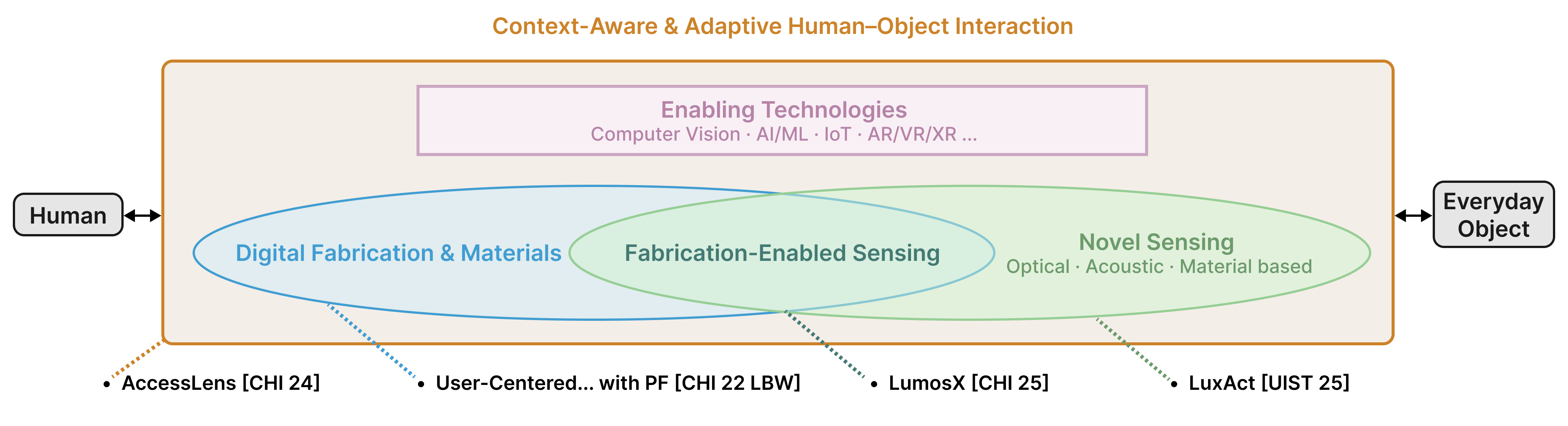
Research overview showing digital fabrication and materials overlapping with novel sensing to enable context-aware and adaptive human-object interaction. Publications are mapped to their corresponding research areas.

News

  • Oct. 2025 - I passed my PhD prelim exam!
  • Aug. 2025 - One paper accepted at UIST'25.
  • Jan. 2025 - My first first-authored full paper accepted at CHI'25!
  • Jan. 2024 - One paper accepted at CHI'24.
  • Jan. 2023 - Started my PhD life at Texas A&M!
  • May. 2022 - Presented my LBW paper virtually at CHI'22.
  • Feb. 2022 - My first LBW poster accepted at CHI'22!
  • Feb. 2022 - My first time entering industry as a full-time software engineer.
  • Dec. 2021 - I graduated from Texas A&M with B.S. Computer Science!

Publications

The video shows an LuxAct real life storage indication application.

LuxAct: Enhance Everyday Objects for Visual Sensing with Interaction-Powered Illumination (UIST'25)

Xiaoying Yang, Qian Lu, Jeeeun Kim, Yang Zhang

A self-powered, ultra-low-cost system that lets everyday objects encode interaction and sensor data into RGB light patterns that AR headsets can read, enabling rich, ubiquitous sensing without embedded electronics.

Augmented Reality Computer Vision Visible Light Communication C++ / OpenCV Hardware Prototyping
More Details

LuxAct enables everyday objects to communicate information through patterns of light that can be captured by AR headsets and cameras. The system uses visible light communication (VLC) to encode interaction and sensor data into RGB LED signals. A real-time computer vision pipeline built with C++ and OpenCV processes these signals using spatial and temporal image features and graph-based LED tracking. Custom hardware modules demonstrate the system across ten augmented reality applications.

DOI |

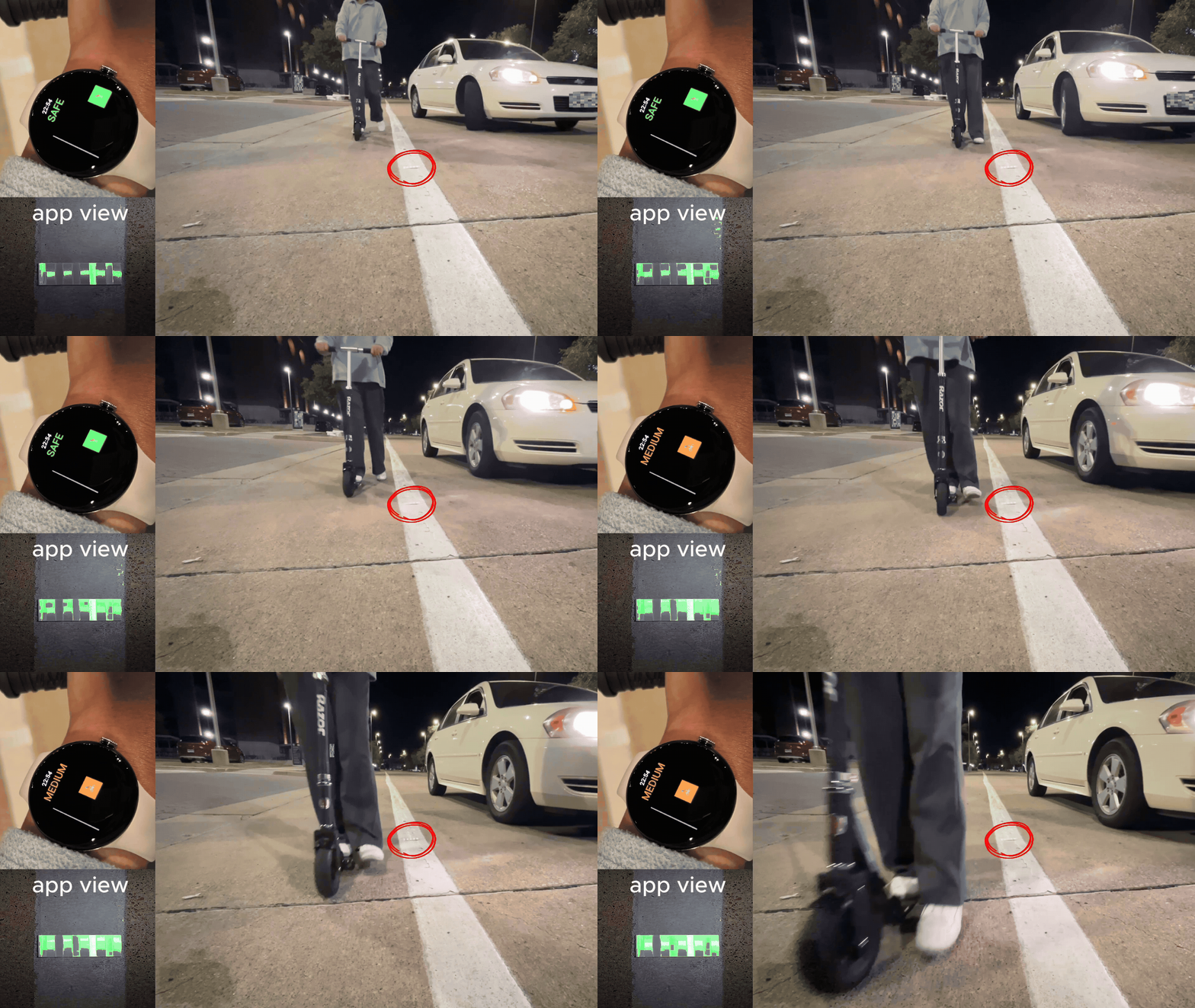
The video shows a real life car distance ditection application.

LumosX: 3D Printed Anisotropic Light-Transfer (CHI'25)

Qian Lu, Xiaoying Yang, Xue Wang, Jacob Sayono, Yang Zhang, Jeeeun Kim

A set of novel techniques for encoding and decoding information through light reflection changes using 3D-printed optical anisotropic properties.

Optical Sensing Light Reflection Digital Fabrication 3D Printing Computer Vision
More Details

LumosX introduces a low-cost optical sensing technique that uses light reflected from 3D-printed object surfaces to encode and decode information without additional electronics. By modifying the internal filament geometry, the system controls how objects reflect light from different viewing directions, allowing cameras to detect encoded information. The approach explores potential applications in robot vacuum navigation, automotive sensing, and interactive gaming devices.

DOI |

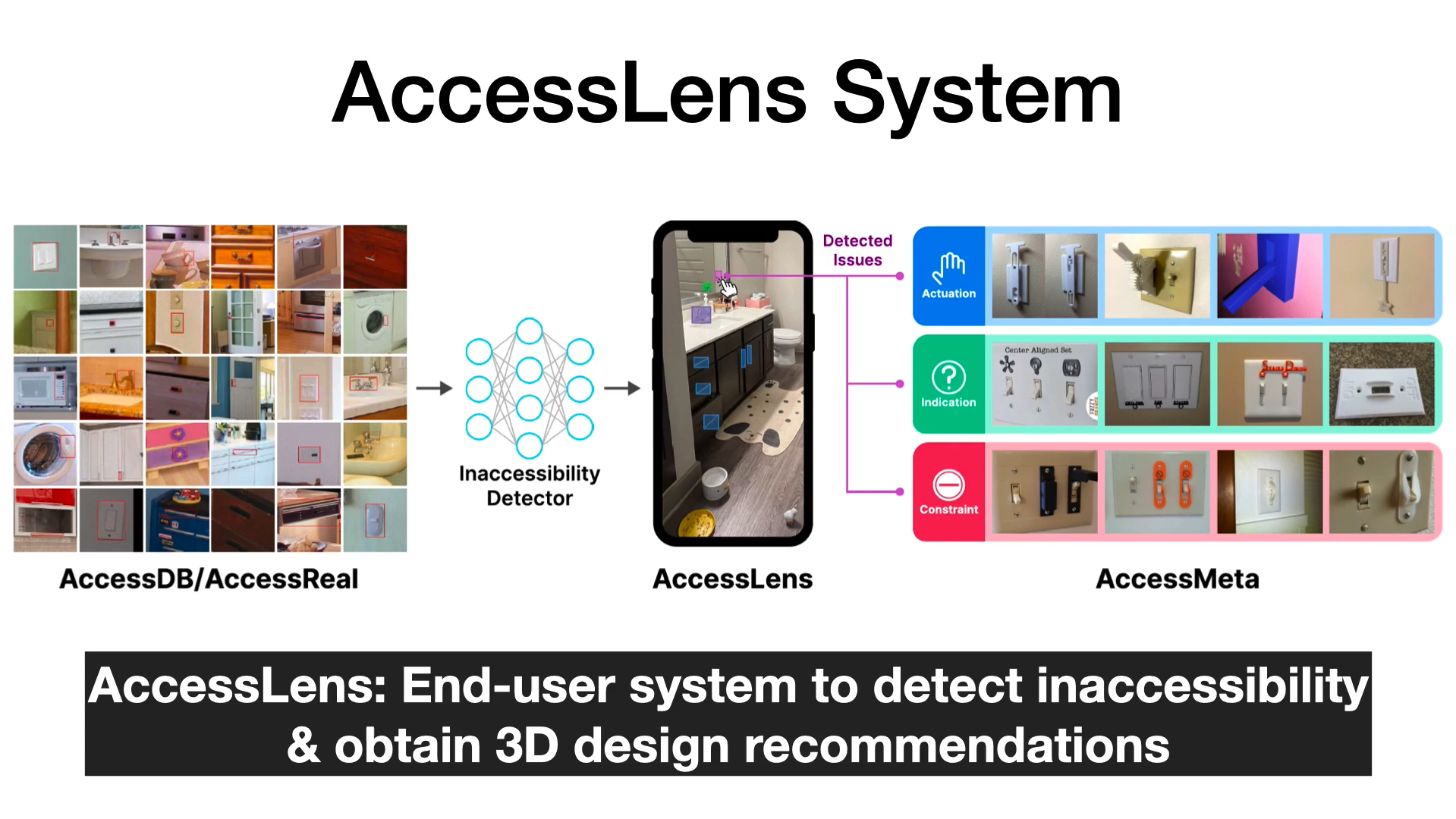
The figure shows a flowchart from left to right. On the left, there is a 5 by 6 grid of images with a bounding box around an item in each image, all from AccessDB and AccessReal. The grid then points to a network icon labeled Inaccessibility Detector, which points to a mobile phone screen that has an image of a bathroom, with bounding boxes around several items in the photo. One of the bounding boxes around the outlet on the wall has an arrow pointing to another diagram that has assistive designs from AccessMeta sorted in three rows: Actuation, Indication, and Constraint from top to bottom.

AccessLens: Auto-detecting Inaccessibility of Everyday Objects (CHI'24)

Nahyun Kwon, Qian Lu, Muhammad Hasham Qazi, Joanne Liu, Changhoon Oh, Shu Kong, Jeeeun Kim

An end-to-end system designed to identify inaccessible interfaces in daily objects, and recommend 3D-printable augmentations for accessibility enhancement.

Computer Vision Machine Learning Object Detection Digital Fabrication Accessibility
More Details

AccessLens combines computer vision, machine learning, and digital fabrication to identify accessibility barriers in everyday environments. Using deep learning-based object detection, the system analyzes images to recognize objects and features that may be difficult to use. Detected accessibility issues are connected to a database of assistive designs, allowing the system to recommend low-cost, 3D-printable modifications that improve accessibility.

DOI |

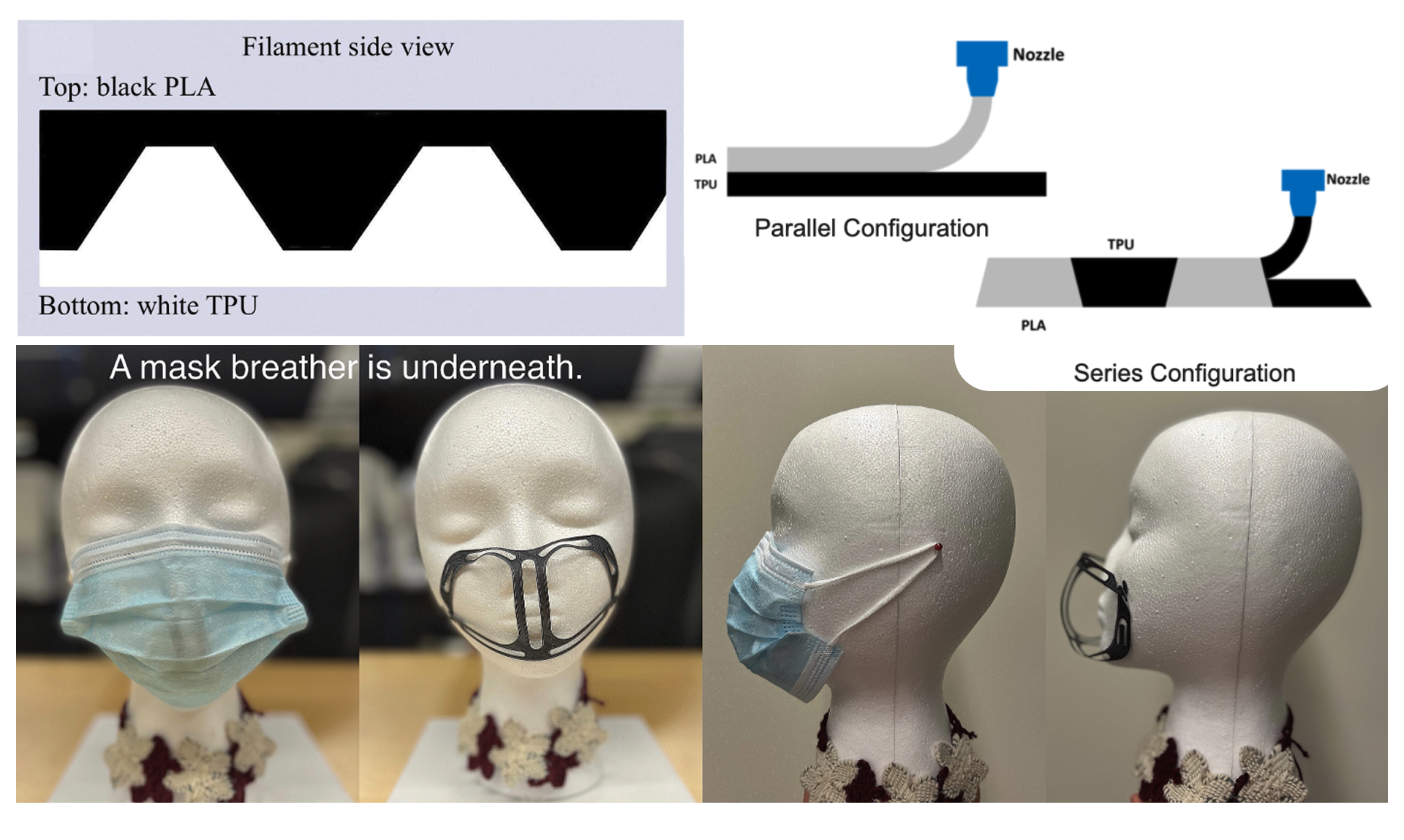
The image shows two configurations of Programmable Filament. The upper one is series configuration, and the lower one is parallel configuration. Both configurations use PLA and TPU as example.

User-Centered Property Adjustment with Programmable Filament (CHI'22 LBW)

Qian Lu, Aryabhat Darnal, Haruki Takahashi, Anastasia Hanifah Muliana, Jeeeun Kim

An exploration of using Programmable Filament to customize the mechanical properties of 3D-printed objects for individual users' needs.

Digital Fabrication Multi-Material 3D Printing Mechanical Property Customization Personalized Fabrication
More Details

This research explores how Programmable Filament can enable low-cost, multi-material 3D printing using conventional FDM printers. By combining materials with different mechanical properties, such as rigid PLA and flexible TPU, the approach allows users to customize properties such as flexibility and softness in fabricated objects. Potential applications include personalized products and wearable accessories designed for individual comfort.

DOI